Bypassing the Shot Quality Argument: Were the 2012-2013 Leafs Lucky?

The true ability of the Toronto Maple Leafs seems to be the subject of never-ending debate in the hockey world. On the one hand, you’ve got the fancy stats crowd who insists that the incredibly high shooting percentages the Leafs have posted since the start of the 2012-2013 season can’t possibly be sustained over a long period of time, and that a crash back down to mediocrity is inevitable. On the other side of the coin, you have the traditionalists who claim that truculence, toughness, and creating and capitalizing on quality chances have driven the Buds to a renewed relevance in the Eastern Conference. Regardless of which side you lean towards, the debate over whether the Leafs are a lucky team or a genuinely good team rests on whether you believe that players or teams can sustain a high shooting percentage over the course of one or more seasons.

I’d propose, however, that we can evaluate the luck argument in a different way, without having to consider whether high shooting percentages can be sustained or not. By examining the historical shooting percentages of the players who played for the Leafs over the course of the last season, and then looking at who was taking the shots for the Leafs last year, we can get an estimate as to how many goals the Leafs should have scored, had they produced at the same rate that they had in the past. If the Leafs scored more goals last year than their historical shooting percentage would have suggested, than we can claim that the Leafs likely had lady luck on their side when they ended their 7 year playoff drought, while if the Leafs total goals for is in line with their past performance it would suggest that perhaps the Leafs really do possess an above-average ability to score goals.

I decided to approach the problem in two ways to get a sense of each teams expected goals for: first, I examined the individual stats for each player with at least 100 even-strength minutes over 2012-2013, and calculated the expected number of goals each player would have scored, given the players actual shot numbers and the shooting percentage they recorded between 2007 and 2012 (stats via stats.hockeyanalysis.com). Second, I took each players historical on-ice Corsi shooting percentage and found how many goals his team would be expected to score, given the number of Corsi attempts he was on the ice for. I then took the delta between each player’s actual and expected goals for, and found the total difference between actual and expected goals for each team using each method. In both cases I looked only at 5v5 shooting percentages, and at players with at least 100 5v5 minutes in 2012-2013. While it would be ideal to compare against historical powerplay performance as well, looking at only even-strength data should give us a pretty good idea of who did better than their historical numbers would have predicted.

Team Delta (Individual) Delta (Corsi)
Anaheim 4.4 1.5
Boston -8.9 -13.8
Buffalo -9.0 -9.3
Calgary 2.4 -1.8
Carolina -13.2 -5.0
Chicago 1.1 8.6
Colorado -4.8 -6.4
Columbus -5.7 -0.3
Dallas -3.7 3.2
Detroit -14.6 -14.8
Edmonton 0.0 0.7
Florida -11.6 -15.3
Los Angeles 3.4 3.5
Minnesota 0.1 -0.1
Montreal 11.0 5.6
Nashville -0.1 -5.0
New Jersey -12.0 -18.8
NY Islanders -3.8 0.6
NY Rangers -8.6 -8.1
Ottawa -9.7 -15.4
Philadelphia -8.9 -7.8
Phoenix 0.3 -4.3
Pittsburgh 9.7 10.4
San Jose -2.8 -12.7
St. Louis -2.0 -1.9
Tampa Bay 12.7 13.9
Toronto 16.9 20.0
Vancouver 0.9 -3.7
Washington -2.7 -1.3
Winnipeg 1.1 -4.3

The chart above lists each team’s total goals for delta using each of methods I described previously. Positive numbers indicate that a team scored more goals than their historical shooting percentage would have predicted, while negative numbers mean that a team underperformed their past shooting percentage. The results in the chart are pretty self-explanatory and sort of demolish the idea that the Leafs success can be credited to Dave Nonis putting together a group of strong goal scorers. In 2012-2013 the Leafs scored between 17 and 20 more goals than their historical shooting performance suggested they would have, the biggest delta of any team last year. The closest overperformer was the Tampa Bay Lightning who put up about 13.5 more goals than would have been expected, while the New Jersey Devils seemed to be the biggest laggard, scoring between 12 and 19 fewer goals than their track record would have predicted.

How much were those extra 17-20 goals worth for the Leafs? We can put together an estimate by reducing/increasing each teams Goals For by the amounts listed in the table above and then calculating their Pythagorean Winning % (the Pythagorean Win % is a simple method to estimate what a teams win percentage should be given their goals for and against, and is very strongly correlated with actual winning percentage). In the table below I’ve listed each team’s Winning %, Pythagorean Winning %, and Pythagorean Winning % based on historically adjusted Goals For.

Team Win% Pyth Win% Adj Pyth Win% (Individual) Adj Pyth Win% (Corsi)
Anaheim 62.50% 57.59% 55.94% 57.02%
Boston 58.33% 58.94% 62.19% 63.82%
Buffalo 43.75% 41.88% 45.50% 45.62%
Calgary 39.58% 39.93% 39.03% 40.59%
Carolina 39.58% 38.95% 43.75% 40.80%
Chicago 75.00% 70.23% 69.91% 67.71%
Colorado 33.33% 36.61% 38.55% 39.20%
Columbus 50.00% 50.00% 52.42% 50.11%
Dallas 45.83% 45.18% 46.60% 43.94%
Detroit 50.00% 55.16% 60.65% 60.74%
Edmonton 39.58% 46.85% 46.85% 46.56%
Florida 31.25% 29.13% 33.49% 34.83%
Los Angeles 56.25% 56.91% 55.61% 55.57%
Minnesota 54.17% 47.12% 47.07% 47.16%
Montreal 60.42% 58.09% 54.25% 56.19%
Nashville 33.33% 40.18% 40.22% 42.36%
New Jersey 39.58% 44.84% 50.01% 52.71%
NY Islanders 50.00% 49.63% 51.04% 49.39%
NY Rangers 54.17% 57.65% 60.82% 60.64%
Ottawa 52.08% 55.64% 59.70% 61.88%
Philadelphia 47.92% 47.42% 50.67% 50.28%
Phoenix 43.75% 48.37% 48.24% 50.13%
Pittsburgh 75.00% 64.95% 62.09% 61.86%
San Jose 52.08% 51.75% 52.96% 56.89%
St. Louis 60.42% 54.19% 55.00% 54.95%
Tampa Bay 37.50% 50.00% 45.49% 45.04%
Toronto 54.17% 56.20% 50.04% 48.82%
Vancouver 54.17% 52.95% 52.57% 54.44%
Washington 56.25% 55.78% 56.68% 56.21%
Winnipeg 50.00% 44.40% 43.98% 46.08%

When we bring the Leafs back down to their 2007-2012 shooting rates, their winning percentage drops from a respectable 54% (tied with Vancouver) down to around the 49% mark, which would likely have left them out of the playoff picture last year. The Minnesota Wild also appear to have been lucky in qualifying for the 2012-2013 playoffs, although their luck was more in outperforming their general Pythagorean Expected Win % than in scoring at a higher rate than we’d expect (The Wild’s GF rate was almost exactly in line with what we would have expected from their past shooting percentages).

I think these results basically point to three possibilities for the 2012-2013 Leafs:

1)      The Leafs were lucky to post such a high shooting percentage, and likely made the playoffs based more on luck than repeatable skill.

2)      The Leafs players underperformed their true goal scoring ability between 2007 and 2012, and finally realized their potential in 2012-2013.

3)      Randy Carlyle’s coaching system makes players better shooters and increases their shooting percentage above their historical rate.

Personally, only one of those 3 scenarios seems reasonable to me, and it’s not option 2 or 3. Regardless of where you stand on the whole shot quality argument, the Leafs definitely scored far more goals last year than their players’ past performance would suggest is reasonable. While the Leafs are sitting in a good spot atop the new Eastern Conference right now, I wouldn’t bet on their ability to keep it up-eventually the percentages are going to catch up with them and bring them back down to earth.
Tagged with: , ,
Posted in Shooting Percentage

Lucky or good: 2012-2013 Historical Comparables

The New Jersey Devils were the poster child for bad luck last year. In spite of putting up a 55.6 CF% in close situations, the Devils couldn’t seem to get the puck into their opponents net or to keep it out of their own. Finishing with a 984 PDO, the Devils slid from Stanley Cup finalists to lottery picks, amassing only 48 points over the shortened season and finishing 11th in the East.

The Toronto Maple Leafs, on the other hand, seemed to have all the bounces go their way. The Leafs somehow managed to overcome a dreadful 43.6 CF% to make the playoffs for the first time since before the 04/05 lockout. Not only did Joffrey Lupul put up an otherworldly 18% even-strength on-ice shooting percentage, but James Reimer also emerged as the number one goaltender Buds fans had been waiting years for, posting a .924 even strength save percentage in 33 regular season games. The number that their detractors keyed in on though was their PDO (ok, everyone noticed the CF% too): at 1029, the Leafs couldn’t possibly sustain their position in the standings for very long, and were certainly due to come crashing back to Earth.

All over the shortened season, fans have bemoaned their team’s lack of luck, or cursed the favour the hockey gods seemed to have bestowed upon their rivals. A good question to ask though, is how much luck did the Leafs/Pens/Ducks/Insert Your Preferred Team Here actually get, and how much of their results should we have expected. While extreme PDO numbers are generally thought of as our best indicator of good or bad luck, there is at least some evidence that the two components of PDO (shooting and save percentage) are repeatable skills.

Even if we just suspect that PDO may be representative of skill rather than luck, we still have ways that we can look into how lucky or unlucky a particular team was given the stats they managed to post. One way of doing that is to look at which teams from the past that were similar to a given team, and then to compare the winning percentage that our 2012-2013 teams achieved with what their historical counterparts managed to post. Any teams that exceeded the winning percentage of their comparables can be considered relatively lucky, while those that underperformed are probably wishing that the season had been a full 82 games.

To figure out which teams were appropriate historical comparisons, I took all the team-level 5v5 Close data from the past 6 years from stats.hockeyanalysis.com and computed z-scores for each team’s CF20, CA20 and PDO. I then found each team’s 5 nearest neighbours using these metrics, and calculated a weighted average expected winning percentage and points percentage, the results of which are shown in the table below.

Team Avg. Distance Nearest Distance Win% Pts% Neighbour Win% Neighbour Pts. % Win% Out(under) perform Pts% Out(under) perform
Anaheim 0.620 0.498 62.50% 68.80% 50.26% 55.11% 12.24% 13.69%
Boston 1.000 0.657 58.33% 64.60% 59.25% 63.83% -0.91% 0.77%
Buffalo 0.627 0.280 43.75% 50.00% 52.93% 56.28% -9.18% -6.28%
Calgary 0.957 0.636 39.58% 43.80% 39.66% 44.02% -0.08% -0.22%
Carolina 1.252 0.714 39.58% 43.80% 44.55% 50.49% -4.96% -6.69%
Chicago 1.074 0.847 75.00% 80.20% 54.64% 59.80% 20.36% 20.40%
Colorado 0.851 0.459 33.33% 40.60% 38.56% 42.82% -5.23% -2.22%
Columbus 0.686 0.540 50.00% 57.30% 53.06% 57.54% -3.06% -0.24%
Dallas 0.734 0.606 45.83% 50.00% 51.94% 58.02% -6.10% -8.02%
Detroit 0.657 0.580 50.00% 58.30% 50.14% 55.60% -0.14% 2.70%
Edmonton 0.544 0.255 39.58% 46.90% 43.21% 47.78% -3.63% -0.88%
Florida 2.455 2.178 31.25% 37.50% 42.50% 46.14% -11.25% -8.64%
L.A. 0.704 0.325 56.25% 61.50% 59.07% 64.08% -2.82% -2.58%
Minnesota 0.538 0.435 54.17% 57.30% 40.37% 46.11% 13.80% 11.19%
Montreal 0.474 0.369 60.42% 65.60% 54.77% 59.47% 5.65% 6.13%
Nashville 0.989 0.758 33.33% 42.70% 44.56% 49.39% -11.23% -6.69%
New Jersey 1.144 0.819 39.58% 50.00% 50.60% 55.06% -11.01% -5.06%
NY Islanders 0.400 0.309 50.00% 57.30% 49.94% 54.44% 0.06% 2.86%
NY Rangers 0.595 0.224 54.17% 58.30% 51.61% 55.90% 2.56% 2.40%
Ottawa 0.483 0.355 52.08% 58.30% 54.78% 59.04% -2.69% -0.74%
Philadelphia 0.402 0.203 47.92% 51.00% 43.86% 49.51% 4.06% 1.49%
Phoenix 0.337 0.211 43.75% 53.10% 51.86% 57.81% -8.11% -4.71%
Pittsburgh 1.271 0.837 75.00% 75.00% 57.63% 63.33% 17.37% 11.67%
San Jose 0.460 0.235 52.08% 59.40% 54.79% 59.29% -2.70% 0.11%
St. Louis 0.738 0.627 60.42% 62.50% 44.16% 49.68% 16.25% 12.82%
Tampa Bay 0.644 0.553 37.50% 41.70% 38.46% 42.87% -0.96% -1.17%
Toronto 1.707 1.637 54.17% 59.40% 43.71% 49.76% 10.45% 9.64%
Vancouver 0.698 0.254 54.17% 61.50% 58.32% 61.73% -4.15% -0.23%
Washington 0.556 0.473 56.25% 59.40% 46.45% 52.40% 9.80% 7.00%
Winnipeg 0.821 0.564 50.00% 53.10% 50.58% 56.55% -0.58% -3.45%

The first thing to notice is that the shortened season does seem to have had quite a large effect on the standings, with many teams finishing far away from their expected level given their historical comparables. Looking at the table, we see that the results range from underperforming by 11.25% (Florida) to overperforming by 20.36% (Chicago). This isn’t to say that Chicago was necessarily a bad team (or that Florida was a good team by any means), but rather that we’d expect a team who generated roughly as many Corsi events for and against as Chicago, and whose PDO was in a similar range to win only about 54.6% of their games, rather than the 75% the Blackhawks managed to achieve last year. To contrast this with 2011-2012, the range of under/outperform was between 6.46% underperform to 1.44% overperform, which suggests that 48 games doesn’t seem to be enough time for the randomness of hockey to sort itself out fully, and for most teams to reach their true talent winning percentage.

But back to where we started: the Leafs and the Devils. Looking at the data, we can see that New Jersey definitely does have reason to claim that fortune wasn’t on their side. Lou Lamoriello’s club underperformed their expected winning percentage by 11%, good for the 3rd worst underperform of any team, and the 7th furthest in absolute terms from their expected winning percentage. It’s interesting to see that the Devils did appear to do decently enough in terms of points percentage: their 5.04% underperform was roughly in the middle of the pack for teams in the league this year.

On the other hand, while the Leafs also finished far from where their historical peers would have suggested, they were definitely not the luckiest team in the league last season. At 10.5% above their expected winning percentage (and 9.4% above their expected points percentage), the Leafs were still behind Chicago, Pittsburgh, Anaheim, St. Louis and Minnesota in terms of outperformers. What might be most important to note though is how different the Leafs were from all the teams in our historical set. The Leafs had the 2nd farthest nearest neighbour and 2nd largest average neighbour distance of all the clubs from last year. What this means is we can’t necessarily trust our prediction of the Leafs expected winning percentage as much as we’d like, given how few similar teams we’ve seen over the last 6 years. This may also give us some hints as to how Toronto managed to do so well when their closest comparables have tended to fail pretty miserably.

A few stray observations:

  • Moreso than the Leafs, Florida was a really unique team last year. The Panthers were the furthest from any team in the past 6 years, driven mostly by their unbelievably terrible PDO. The Panthers combined shooting and save percentage was a dreadful 951, 23 points below their closest neighbour. Even if we were optimistic and brought them up to the same level as their neighbours, their 46.4% points percentage would have had them in the bottom 6 in the league.
  • While the Blackhawks and Penguins certainly had good seasons, looking at their expected winning percentages it becomes clear that it’s unlikely they would have been able to keep up their pace over the course of a full season. In the salary-cap era NHL it’s simply too difficult for a team to earn more than 75% of their possible points.
  • Team to watch out for this year (excl. NJ): Phoenix. The Coyotes actually had the lowest average distance of all teams last year (meaning we have a pretty good estimate of how they should have done), and their comparables were very favourable: if they’d won at the same rate as the teams most similar to them statistically, they would have just edged out Minnesota for the last playoff spot in the West.
  • Team who may be in for a rude awakening this year (excl. Toronto): St. Louis. I’m really pulling for Brian Elliott and co. to keep things together, but the numbers don’t seem to support their ability to do so. Their closest comparables posted a sub-.500 average record, and given Elliott’s track history you have to wonder how long he can keep up his world-beating play.
Tagged with:
Posted in Uncategorized

Do defensemen play worse on their off-hand?

Steve Yzerman apparently has a problem. A right-handed defenseman problem.  The former Red Wing and current Team Canada general manager has too many talented right-handed defensemen at his disposal and is now stuck deciding between sending out a balanced lineup or one that might force some of the best hockey players in the world to line-up on the other side of the ice for a few games.

Admittedly, this is not really the type of problem that most people would consider a problem. But, as a responsible Canadian citizen committed to avoiding a national tragedy in Sochi, I wanted to help Stevie Y out by giving him as much information as possible before he makes his decision. With that in mind, I decided to look into whether pairing a lefty and a righty together really provides as much of an advantage as the media seems to suggest.

To do this, I took all the individual shift and play-by-play data from the 2010-11, 2011-12, and 2012-13 seasons and calculated how often each team sent out 2 same-handed defensemen (meaning one player must be on his off-side) vs. 2 opposite-handed defensemen (presumably not playing on their off-sides, although there’s no real way to check this assumption). I then pulled together each pairings on-ice goal and shot statistics, as well as individual goal, assist and shot numbers to look into whether having an opposite-handed pair provided a significant advantage.

In total, there were 2712 defensive pairs who played at least 1 second of ice-time together over our 3-year sample period (led by the Ryan McDonagh/Dan Girardi and Shea Weber/Ryan Suter pairs who both played together for over 1700 total minutes). Of the 264 defenseman, the sample definitely skewed to the left side, with only 98 right-handed defenseman (37.1%) vs. 166 lefties (62.9%). In terms of the ice-time distribution, the opposite-handed pairings received 61% of the total minutes, which seems in line with what you’d expect in a world where coaches prefer to keep players away from their off-hand, but can’t always do that (due to the lefties outnumbering the righties).

Looking at the data, however, it’s not really clear whether this strategy has much benefit.

On-Ice Stats GF/60 CF/60 FF/60 BS/60
Opposite 2.56 55.80 41.58 14.21
Same 2.53 53.59 40.19 13.40
Delta 0.04 2.20 1.39 0.81

Opposite handed pairs do seem to have a slight-advantage in both shot attempt and goal generation: they’re on the ice for more Corsi and Fenwick events for per 60 minutes of ice time, and they also recorded a higher GF/60 rate (Some of the deltas don’t match up exactly, but that’s just due to rounding). That 0.04 GF/60 advantage works out to around 2.97 extra goals over the course of an entire season, although that’s only in the most extreme scenario (all opposite-handed vs. all same-handed pairs). To put that 0.04 GF/60 in context, P.K Subban’s GF/60 since 2010 is 0.859, far above Karl Alzner (0.700), Jay Bouwmeester (0.709) and Dion Phaneuf (0.773), all of whom have been mentioned as possibilities to fill out the Canadian defensive corps should Yzerman elect to ice a balanced lineup.

In terms of the individual stats, we see a similar trend as with the on-ice data. About 50% of the GF/60 advantage that opposite-handed pairs appear to be the result of goals scored by defensemen, but again, the difference is very small. It’s also interesting to note that most of the increase in Corsi events we see (75%) is due to the defensemen themselves attempting more shots, and that most of the additional blocked shots are coming off the sticks of defensemen.

Individual Stats iGF/60 1A/60 2A/60 A/60 iCF/60 iFF/60 iBS/60
Opposite 0.37 0.07 0.04 0.11 18.40 12.20 6.20
Same 0.36 0.06 0.04 0.11 16.76 11.21 5.55
Delta 0.02 0.00 0.00 0.00 1.64 0.99 0.66

One thing to keep in mind is that we’ve been looking at all minutes, and all points in the tables above, regardless of the situation (EV/PP/SH). Pulling together the EV and PP data is a bit trickier, since there’s no easy way to separate out the even-strength shifts from the power-play shifts (the goals and Corsi/Fenwick events are easier). What we can look at, however, is how the total stats in each situation break down between opposite-handed pairs and same-handed pairs.

Situational Breakdown iGF 1A 2A A CF FF
Even Opposite 65.05% 69.66% 65.29% 67.67% 64.50% 64.35%
Same 34.79% 30.34% 33.88% 31.95% 35.16% 35.30%
PP Opposite 53.55% 57.52% 51.95% 55.65% 56.43% 56.46%
Same 46.45% 42.48% 48.05% 44.35% 43.50% 43.47%

This is where I think the data starts to get a bit more interesting-if you’ll recall, our total TOI breakdown was roughly 61% opposite-handed vs. 39% even-handed, or roughly in the same neighbourhood of what we see for the even-strength data. On the power-play though, the situation changes drastically, with same handed pairs producing nearly half of the goals scored by defensemen, and similar split being seen in the other offensive metrics. I’d suggest that there are 2 possible explanations for what we’re seeing here:

1)      The distribution of ice-time between same-handed and opposite-handed pairings is different on the power-play than during even-strength play. Coaches may be more likely to put their two “best” defensemen together, regardless of handedness, on the power-play, whereas they may attempt to balance their pairings during even-strength play.

2)      The ice-time breakdown is the same in both even strength and power-play situations, but same-handed pairings are more effective on the power-play than during even-strength play. This doesn’t seem to be an unreasonable explanation: with more time to set up having a defenseman on his off-side for a one-timer may be more valuable on the power-play.

If I had to choose between the two, I’d lean towards the former over the latter: while the goal data certainly suggests that explanation #2 is possible, I think we’d probably see more of a split towards same-hand pairs in the 1A data if this were what was driving the PP numbers. If that’s the case though, it means that the difference in ES GF/60 rates is probably smaller than what we’d estimated above, lending more weight to the argument that playing on your off-hand isn’t necessarily that much of a detriment. Over the course of a short tournament like the Olympics, I think it’s far more important to select the best set of defensemen possible, rather than worrying about finding players to fill certain roles or maintaining “balance” throughout a lineup.

Posted in Uncategorized

Examining Rebound Control

Earlier this week, Rob Pettapiece had an interesting article over at NHL Numbers on rebound control, where he looked at the percentage of shots a goaltender faced that resulted in a rebound (which he defined as a shot within the 3 seconds following another shot). In the article, he concluded that while some goalies do appear to be able to control rebounds better than others, the effect of rebound control wasn’t that large, and wasn’t one that persisted year over year. While I agree with Rob’s conclusions based on his data, I worry that looking at the % of saves that result in a rebound is really a combination of three factors: 1) the goalie’s ability to control his rebounds; 2) his teammates’ ability to clear away any rebounds he does give up; and 3) his opponents’ ability to drive the net and get a shot, given a rebound opportunity.

With that in mind, I decided to take a look at things from a different point of view, considering how many saves a goalie made where the puck was frozen in the next 3 seconds. Hopefully looking at it through this lens will allow us to eliminate most of the team/opponent effects and focus on a goalie’s ability to control what happens after he makes a save.

Using the Play by Play data from the 2010-2011 and 2011-2012 seasons, I compiled a list of all even strength shots on net and recorded whether or not there was a stoppage coded as either “Puck Frozen” or “Goalie Stopped” (if anyone knows the difference between these two codes, if there even is one, please let me know). I then calculated the % Frozen by dividing the total number of stoppages by the total number of saves made.

In total there were 110,271 Even Strength Saves in the sample, with 30,557 of those being frozen in the next 3 seconds, giving an average % Frozen of 27.7%. The table below has the top and bottom 10 goalies who faced at least 500 shots over the 2 year period in our sample.

Top 10 Bottom 10
Goalie % Frozen Goalie % Frozen
RINNE, PEKKA 36.40% HILLER, JONAS 24.94%
BOUCHER, BRIAN 34.67% GARON, MATHIEU 24.56%
HARDING, JOSH 34.64% MASON, STEVE 24.41%
NEUVIRTH, MICHAL 32.70% GUSTAVSSON, JONAS 24.16%
BACKSTROM, NIKLAS 32.36% MCELHINNEY, CURTIS 24.03%
RAYCROFT, ANDREW 32.29% VARLAMOV, SEMYON 23.78%
BERNIER, JONATHAN 31.79% THEODORE, JOSE 22.64%
BOBROVSKY, SERGEI 31.21% FLEURY, MARC-ANDRE 22.01%
MASON, CHRIS 30.90% BRODEUR, MARTIN 21.19%
REIMER, JAMES 30.57% KHABIBULIN, NIKOLAI 21.18%

We do see a little overlap with Rob’s list, with Pekka Rinne once again way out in front, and with Michal Neuvirth and James Reimer appearing in the top 10 of both lists. On the bottom half we see some interesting names, with Marty Brodeur and Marc-Andre Fleury taking 2 of the bottom 3 spots. Jonas Hiller also makes an appearance in the lower group, but other than that there aren’t too many names that standout from the “Worst Of” list.

The question then is how much of this data is skill versus luck or randomness. The good news is that the % of saves frozen does seem to be a repeatable skill (at least over the two years in our sample). Between 2010-2011 and 2011-2012 the correlation for goalies who made at least 250 even strength saves was 0.69, and the split half correlation was 0.68 (when split on the game number) and 0.69 (when split on the play-by-play number).

R R^2
2010-2011/2011-2012 0.687 0.473
Even-Odd Games 0.683 0.467
Even-Odd Plays 0.690 0.476

With that being said, the ability to freeze the puck doesn’t seem to be a huge determinant of team success (most people probably would have guessed that when they saw Andrew Raycroft in the top 10). The R^2 between Percent Frozen and Regulation/OT Wins is 0.0515, while for total points it’s slightly lower at 0.0508, and the correlation with even strength save percentage is very small (0.11).

I suspect that there are a few things at play here: First, while rebounds are undoubtedly more dangerous shots, they result in a shot attempt so rarely that they play a relatively smaller role in the overall results. Second, inevitably each frozen puck results in a defensive zone draw, putting the goalie at an immediate disadvantage, and potentially counteracting some of the benefit of preventing a rebound.

The other element that may have an effect is that some goalies could be better at safely deflecting shots away (i.e. into the corners) which would decrease their % Frozen but could be more of a contributor to overall team success. I suspect that may be the case for some of the bigger names on the lower end of the scale, and for some of the higher ranking goalies for Rebound % who were below average by % Frozen. I think that looking at some combination of the two metrics will likely give us a better sense as to a goalie’s “true” rebound control ability, if one does exist.

Tagged with: ,
Posted in Goaltending

Shots Against and Even Strength Shooting Percentage

I had a discussion on twitter the other day about the relationship between shots against and save percentage. I wrote earlier about how on an individual game basis, save percentage tends to increase as the number of shots against increases. @pcunneen19 suggested that it was possible that the trend that I’d noticed was due to the fact that I’d looked at overall save percentage, rather than even strength save percentage, which tends to be a better indicator of future success in goaltending.

With that in mind, I went back and pulled the situational shot data from the Event Summaries for games from the 2008-2009 season to the 2011-2012 season. It’s not a perfect data set, as it doesn’t indicate who was in net in a given game, and there are some empty net goals included, but for our purposes it should be good enough.

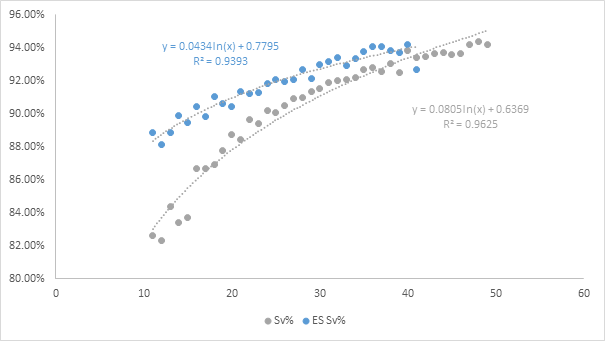
ES Save % vs Shots Against

The graph above shows the aggregate save percentage grouped by the number of shots against (or even strength shots against) in a given game (where there was more than 1000 total shots against). As I’ve mentioned before, total Sv% tends to increase logarithmically as shots against increases, and we see a similar (albeit less pronounced) trend with ES Sv%. Based on the trendline above, jumping from 20 even strength shots per game to 25 produces an expected increase in even strength save percentage of 2%.

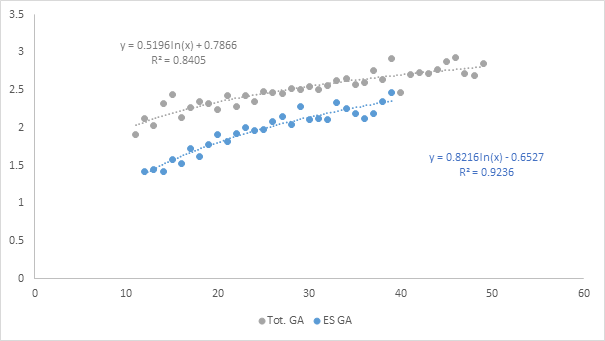
On a related note, if we look at expected even strength goals against, we also see a logarithmic trend, as we did with total shots against. Again, the ES data is just at the team level and not the goalie level, but it appears as if the trends that exist in the total shot data can also be seen in the event strength data.

ES Goals Against vs. Shots Against

I’m still evaluating to what degree this trend holds at the individual level for even strength shots. If we group total shots against into buckets of 5 and look at individual goaltender save percentages for each bucket (with a minimum of 10 GP), we do see that save percentage tends to increase as shots against goes up, although it’s not always absolutely true. I’ll try to put together a similar chart for ES Sv% to see if it appears to behave the same way as well.

Goalie 15-20 20-25 25-30 30-35 35-40 40-45
ANDERSON, CRAIG   89.31% 90.72% 92.40% 92.91% 93.96%
AULD, ALEX 88.36% 89.70% 90.48% 92.15%    
BACKSTROM, NIKLAS 83.67% 90.33% 91.40% 92.19% 93.72% 94.83%
BIRON, MARTIN   91.67% 89.99% 92.09% 92.30% 92.55%
BOBROVSKY, SERGEI   89.62% 90.75% 93.65% 93.69%  
BOUCHER, BRIAN   91.34% 90.22% 92.15% 91.99%  
BRODEUR, MARTIN 87.66% 90.90% 91.34% 92.67% 93.09%  
BRYZGALOV, ILYA 85.11% 89.46% 91.99% 91.85% 92.54% 93.76%
BUDAJ, PETER 87.63% 87.83% 90.32% 91.23% 91.88%  
CLEMMENSEN, SCOTT 89.33% 88.31% 90.99% 90.18% 92.91% 94.37%
CONKLIN, TY   88.08% 91.42% 90.08% 94.25%  
CRAWFORD, COREY 87.67% 90.48% 91.10% 93.32% 92.20%  
DUBNYK, DEVAN   89.75% 89.13% 91.41% 93.30% 94.15%
ELLIOTT, BRIAN 86.75% 90.18% 91.18% 91.83% 93.04%  
ELLIS, DAN 87.18% 90.13% 89.99% 91.80% 93.56% 94.59%
EMERY, RAY 88.03% 91.91% 89.78% 91.61% 91.08%  
FLEURY, MARC-ANDRE 87.82% 90.00% 91.56% 92.28% 93.53%  
GARON, MATHIEU 86.22% 88.86% 90.90% 91.07% 92.61%  
GIGUERE, JEAN-SEBASTIEN 89.32% 90.91% 90.32% 91.74% 93.15%  
GUSTAVSSON, JONAS   90.50% 90.13% 90.63% 91.03%  
HALAK, JAROSLAV 88.07% 90.63% 91.06% 92.63% 92.41%  
HARDING, JOSH   90.97% 90.42% 88.85% 93.73%  
HEDBERG, JOHAN 87.36% 89.18% 89.57% 92.07% 91.67%  
HILLER, JONAS 87.58% 89.40% 90.80% 92.77% 93.04% 93.50%
HOWARD, JIMMY 88.55% 90.61% 91.35% 93.03% 92.20%  
HUET, CRISTOBAL 88.50% 90.83% 90.75% 91.99%    
KHABIBULIN, NIKOLAI 86.83% 87.50% 90.99% 90.76% 93.00%  
KIPRUSOFF, MIIKKA 86.62% 88.26% 91.06% 91.66% 93.21% 94.30%
LABARBERA, JASON 88.99% 90.42% 89.16% 92.57% 91.38%  
LECLAIRE, PASCAL   89.55% 90.32% 91.92% 90.55%  
LEHTONEN, KARI   89.47% 90.80% 91.31% 92.90% 93.21%
LUNDQVIST, HENRIK 86.68% 90.18% 92.57% 92.59% 93.55% 95.47%
LUONGO, ROBERTO 85.65% 90.03% 91.56% 93.27% 93.12% 94.18%
MACDONALD, JOEY   88.95% 89.18% 91.19% 90.00%  
MASON, CHRIS 81.78% 90.19% 90.80% 92.19% 92.39%  
MASON, STEVE 85.71% 88.59% 88.79% 91.76% 91.91% 93.27%
MILLER, RYAN 86.69% 88.59% 91.58% 91.77% 93.45% 93.97%
NABOKOV, EVGENI 86.44% 89.24% 90.72% 93.05% 93.42%  
NEUVIRTH, MICHAL   90.78% 90.31% 91.87% 92.36%  
NIEMI, ANTTI 89.42% 91.21% 91.98% 92.64% 92.13%  
NIITTYMAKI, ANTERO   87.72% 90.93% 90.77% 93.41%  
OSGOOD, CHRIS 86.06% 90.07% 89.05% 92.07%    
PAVELEC, ONDREJ   85.64% 91.39% 91.79% 91.00% 92.43%
PRICE, CAREY 89.06% 88.43% 91.04% 92.12% 92.73% 93.18%
QUICK, JONATHAN 88.01% 90.36% 91.77% 92.13% 92.91%  
RASK, TUUKKA   91.61% 91.77% 92.46% 94.01%  
RAYCROFT, ANDREW   88.70% 87.00% 90.24% 92.89%  
REIMER, JAMES     90.75% 92.39% 92.59% 92.36%
RINNE, PEKKA 90.20% 89.47% 90.69% 93.47% 93.73% 95.27%
ROLOSON, DWAYNE   87.07% 90.15% 90.92% 92.92% 92.59%
SCHNEIDER, CORY   92.59% 91.21% 93.60% 93.54%  
SMITH, MIKE 86.67% 88.68% 90.98% 92.26% 92.21% 95.53%
THEODORE, JOSE 83.46% 89.27% 91.66% 91.31% 91.45% 93.60%
THOMAS, TIM 86.28% 89.03% 92.60% 93.18% 93.42% 95.18%
TOSKALA, VESA   87.63% 89.26% 91.53% 91.54%  
TURCO, MARTY 86.28% 88.00% 90.88% 91.79% 92.16% 93.13%
VARLAMOV, SEMYON   87.73% 90.46% 92.47% 92.72%  
VOKOUN, TOMAS 87.45% 89.75% 90.98% 92.22% 93.66% 93.77%
WARD, CAM 87.46% 88.58% 90.43% 91.34% 93.63% 94.49%

I’m not trying to make the argument that goalies who face more shots against will necessarily have a higher save percentage, but rather that in smaller sample sizes an individual goalie’s save percentage could be skewed by the number of shots he faces. Over the long run this should even itself out for most goalies, but it is something to be wary of when using save percentage to evaluate goaltenders.

Posted in Goaltending

GAA- Continued

I’ve added full lists of season-by-season and all-time (since 2007) GAA- leaders here and here respectively. The season-by-season list contains all goalies who played a minimum of 33% of the games during a given season, while the all-time list contains all goalies who played in a minimum of 80 games since 2007. I spent some time in my last post going through the best and worst seasons over the past 5 years, but I wanted to talk a bit about the full leaderboard because I think there are some valuable things to be taken from it.

The first thing that strikes me as interesting is that of the 63 goalies who have played in at least 80 games over the past six years only 23 have prevented more goals than the model predicted an average goaltender would have, given the amount of shots they faced. The list of goalies who are below average includes some reasonably big names who have put together some decent seasons over the past few years but haven’t been consistently great (Mike Smith, Carey Price, Cam Ward, Kari Lehtonen and Ilya Bryzgalov). The list of “overrated” goalies does skew towards those goalies who face more shots on average, but that isn’t the exclusive determining factor. Tim Thomas faced more than 30 shots per game since 2007, but still ranks 3rd on the overall list.

On the flip side, there were a few goalies who made the net-negative group in spite of posting a sub 0.910 Sv% (Brian Boucher, Brian Elliot and Cristobal Huet). All three of these goalies were towards the lower end of the shots against spectrum, with Boucher’s 24.8 SA per game ending up as the 3rd lowest shots against of qualified goalies on the list. Again, facing fewer shots against likely helped these goalies, but it wasn’t the sole factor pushing them up the list-Manny Legace and Chris Osgood both faced less shots on average than Boucher, but ranked 45th and 55th respectively on the GAA- list.

The point of GAA- isn’t to penalize goalies who face a lot of shots, or to reward goalies who face fewer shots, but rather to provide a means to “break ties” when evaluating goaltenders. Both GAA and Sv% are valuable but have their flaws, and I think finding a way to balance the two metrics provides more information than either can individually. Carey Price’s 0.915 Sv% is on par with Jonathan Quick over the last few 5 years, however Quick rates much better on the GAA- scale. Similarly, James Reimer is ahead of several well regarded goalies in Sv% (Quick, Corey Crawford and Martin Brodeur come to mind), but I think most people wouldn’t feel all that comfortable with Reimer going forward (including Dave Nonis apparently).*

The names at the top of the list shouldn’t be surprising if you’ve looked at the season by season list. Tuuuka Rask tops the charts with former teammate Tim Thomas two spots behind in 3rd. Both Corey Schneider and Roberto Luongo make the top 10 in 2nd and 9th respectively. It’ll be interesting to see what Mike Gillis does with Luongo this offseason: this year was only his second year posting a positive GAA- at 0.11 (although the sample size does need to be taken into account), but his 2011-2012 year was solid and should warrant some interest from other teams.

I do question whether we’re seeing some team effects in the data. Both Rask and Thomas had the benefit of playing behind Zdeno Chara and the rest of the Bruins defence, and I have to think that the Rangers shot blocking efforts over the last few years have helped Henrik Lundqvist to a degree. Nevertheless, I don’t think anyone would debate too strongly the merits of any of the goaltenders in the top 10.

At the bottom end of the charts, some disheartening news for Leafs fans, as Jonas Gustavsson, Andrew Raycroft and Vesa Toskala all make appearances in the bottom 10. Also appearing are Flyers “saviour of the month” Steve Mason, and the inexplicably still employed Ondrej Pavelec. Chris Osgood qualifies for the bottom 10 in spite of posting a stellar -0.27 GAA- in 2007-2008. I’d actually be interested to pull a few more years of data to take a closer look at Osgood, who has always been viewed as the poster boy for riding on the back of a good team. Perhaps a project for another day though (or a better internet connection at least).

Lastly, I wanted to talk about Craig Anderson, whose career totals should also be somewhat concerning for Ottawa fans. While Anderson has been lights out for Ottawa since coming over for Brian Elliot, his career numbers (and common sense) seem to question his ability to continue his performance in the coming year. With Robin Lehner waiting in the wings and Daniel Alfredsson’s retirement a strong possibility, trading Anderson for some help up front would likely be a prudent “sell high” move for Bryan Murray. It seems rather unlikely that they’d pursue something like this, but for teams in need of a goalie with parts to spare there could be some value for both sides in asking about Andy.

*As an aside, the newly acquired Jonathan Bernier has a -0.24 career GAA- in 59 games, slightly ahead of Henrik Lundqvist, which puts him as the top goaltender in the 40-80 games played bucket. Going the other way, Ben Scrivens was a 0.13 GAA- player in 32 career games, which essentially put the Leafs up 0.37 goals per game, albeit in a very small sample.

Tagged with: , , ,
Posted in Goaltending

Adjusting GAA for Shots Against

Over my last few posts I’ve been looking into the idea of game level goaltending performances and adjusting goalie evaluation metrics to account for the number of shots against a goalie faces. One of the issues I have with Save Percentage as a method of evaluating goaltenders is that it has the potential to overstate the value of goaltenders who tend to face a lot of shots, or understate the value of a performance when a goalie faces few shots.

To give an example, let’s look at 10 hypothetical games for 2 (obviously hypothetical) goalies, which I’ve set up in the table below. Over the 10 games, each goalie faced the same number of shots and let in the same number of goals (i.e. identical save percentages) but did so in different ways. Goalie A was consistent throughout all the games, while Goalie B performed very well in 3 games, decently enough in four, and very poorly in 3 other games.

Goalie A

Goalie B

Shots Saves Game Sv% Shots Saves Game Sv%
30 28 93.3% 60 59 98.3%
30 28 93.3% 60 59 98.3%
30 28 93.3% 40 39 97.5%
30 28 93.3% 20 18 90.0%
30 28 93.3% 20 18 90.0%
30 28 93.3% 20 18 90.0%
30 28 93.3% 20 18 90.0%
30 28 93.3% 20 17 85.0%
30 28 93.3% 20 17 85.0%
30 28 93.3% 20 17 85.0%

I think most people would agree that they’d rather have Goalie A over Goalie B, and while this is an extreme example, I think it highlights a flaw in Save Percentage as a metric and why more granular game based analysis can be necessary. The three very good games put up by Goalie B shouldn’t cancel out the 3 very bad games.

I’m hesitant to bring up goals against average as a “solution” to this problem, but bear with me for a second. Preventing goals is a goalie’s job, so GAA seems like it should be a natural measure of a goalie’s ability. But GAA has several flaws that really make it a bad metric, primarily that it doesn’t take into account the number of shots against. A goalie who faces 50 shots and lets in 3 goals is given just as much credit as a goalie who faces 20 shots and lets in 3 goals. Clearly if we could adjust GAA to incorporate the number of shots allowed GAA would be a more useful metric. The question then is how we should properly adjust GAA to evaluate a goalie’s performance in a given game.

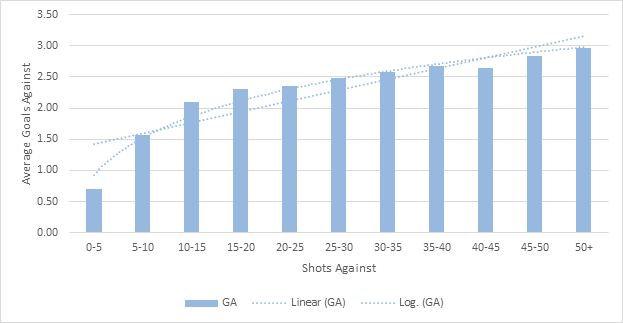
The chart below shows the average goals allowed plotted against the number of shots against for all games since 2007. What we see intuitively makes sense: as the number of shots faced increases so does the number of goals, but the trend is more logarithmic than linear. If save percentage increases with shots against, we wouldn’t expect goals allowed to double just because shots against doubled.

Average GA Per Game vs. Shots Against

Average GA Per Game vs. Shots Against

With this in mind, we can create a model to evaluate how goalies performed on a game by game basis vs. the average goaltender facing the same number of shots. Taking all goaltending performances since 2007, we can look at how many goals we would expect an average goalie to give up, given the amount of shots against. Then, if we look at how many goals a given goalie gave up in each game and compare it to the expected goals against set by our model, we can come up with a shot adjusted goals against metric that provides an estimate of how many additional goals a goalie prevented (or allowed) over the course of a season. I’ll define two new metrics Goals Against Minus (GA-) and Goals Against Average Minus (GAA-) as:

GA- = ∑ GA – E(GA)

GAA- = (∑ GA – E(GA))/N

where GA is the goals allowed in given game, E(GA) is the Expected Goals Against given by the model, and N is the number of games played (ideally this would be the number of minutes played divided by 60, but I haven’t gotten around to setting that up yet).

This new metric has a few nice properties that adjust for what I perceive to be some of the problems with Save Percentage or Goals Against Average as metrics. First, for a constant goals against, a goalie who faces more shots against is rewarded more than a goalie who faces fewer shots. Second, for a constant save percentage, goalies who allow fewer goals against are rewarded more than goalies who allow more goals. And finally, it measures a goalie’s performance on a game-by-game basis, rather than overemphasizing certain games based on the number of shots faced.

The tables below show the top 10 and bottom 10 goalie performances in GAA- for all years since 2007 (for goalies who played a minimum of 33% of the season).

Top 10 Seasons by GAA-  (2007-Present)

Season Player GAA- GA-
20112012 ELLIOTT, BRIAN -0.85 -32.15
20122013 ANDERSON, CRAIG -0.80 -19.14
20102011 THOMAS, TIM -0.59 -33.44
20112012 SCHNEIDER, CORY -0.57 -18.79
20092010 RASK, TUUKKA -0.53 -24.06
20122013 EMERY, RAY -0.53 -11.05
20122013 BOBROVSKY, SERGEI -0.51 -19.27
20112012 LUNDQVIST, HENRIK -0.48 -29.80
20112012 QUICK, JONATHAN -0.48 -32.37
20122013 CRAWFORD, COREY -0.48 -14.26

I think this list really highlights how amazing Brian Elliott’s year last year was. While it does have a bit of a small sample size warning (he only played in 38 of the Blues’ games last year after all), it’s kind of crazy to see how far ahead of the rest of the list he was (Craig Anderson in an even smaller season notwithstanding). He essentially prevented just as many goals as Tim Thomas did in 2010-2011 while playing in 19 less games. Some of it is surely the system, but that number is still outstanding, though it should be noted that Elliott only slightly managed to avoid the Worst 10 Seasons list for his 2010-2011 atrocity (0.59 GAA-).

You’ll notice that the list contains a lot of names from this past season, I suspect that this is due to the small sample size and that some of those netminders (again, sorry Craig Anderson) likely would have come back down to earth over the course of a full year. It’s also interesting (although not altogether unsurprising) to see both of Chicago’s goalies from this year in the top 10. While the strength of their offense has gotten most of the attention, the goaltending definitely played a major part in their domination this year.

Worst 10 Seasons by GAA- (2007-Present)

Season Player GAA- GA-
20122013 KIPRUSOFF, MIIKKA 0.80 19.24
20102011 KHABIBULIN, NIKOLAI 0.78 36.47
20112012 ROLOSON, DWAYNE 0.76 30.34
20082009 HEDBERG, JOHAN 0.75 24.63
20122013 CLEMMENSEN, SCOTT 0.69 12.42
20082009 TOSKALA, VESA 0.67 34.78
20082009 MACDONALD, JOEY 0.66 32.58
20122013 PETERS, JUSTIN 0.66 11.96
20092010 DESLAURIERS, JEFF 0.64 28.03
20092010 TOSKALA, VESA 0.63 20.20

On the other end of the spectrum, I know I’ve said it before but the Leafs were really lucky to avoid trading for 2012-2013 Miikka Kiprusoff. Kipper essentially let in an extra goal in 4 of every 5 games this year, which is probably as good a sign as any that you should retire.

That being said, I don’t think any Leafs fans will be happy to see Vesa Toskala’s name appearing twice on this list (although I doubt that many of them are surprised). And it would surely be rubbing salt in their wounds to point out Tuukka Rask’s name in the 5th spot of the top seasons list, so I won’t go that far. Nor will I point out that Rask is the leader by this metric over the past 6 years, since there’s more than enough data there to warrant another post.

Tagged with: , ,
Posted in Goaltending

Round 2 Prediction Updates

Updated playoff odds based on our game prediction model are given in the table below. For those of you unfamiliar with the model, it uses each team’s Fenwick Close, Regressed Shooting Percentage and Regressed Save Percentage to predict single game results between any given pair of teams. Based on these home/away predictions, we can then generate odds of winning each series, and from those series odds make a forecast about who will take it all.

Team 3rd Round Stanley Cup Win Cup
Chicago 66.3% (+14.7%) 39.9% (+7.0%) 24.1% (+3.6%)
Boston 67.4% (+15.9%) 40.2% (+8.2%) 21.6% (+3.7%)
Los Angeles 61.9% (+28.3%) 30.8% (+12.3%) 16.5% (+6.3%)
Pittsburgh 59.1% (+21.8%) 29.5% (+9.4%) 13.9% (+3.9%)
San Jose 38.1% (+20.1%) 15.2% (+7.1%) 6.6% (+3.0%)
Ottawa 40.9% (+22.7%) 16.2% (+7.8%) 6.2% (+2.7%)
Detroit 33.7% (+13.5%) 14.1% (+5.0%) 6.0% (+1.9%)
NY Rangers 32.6% (+8.8%) 14.1% (+4.2%) 5.1% (+1.3%)

The biggest gains came for the Kings, who moved up 6.3% after rallying for four straight wins against the Blues in round 1. The Canucks loss is also their gain, as the model viewed Vancouver as the 3rd best team in the West, and their elimination makes LA’s path to the cup significantly easier.

Chicago, however, remains at the top of the heap, with the model now having the Hawks with about a 40% chance of making the cup and a 24.1% shot of winning everything. The Bruins remain on top of the East, and have slightly better chances of making the finals than Chicago, primarily due to the weaker competition they’re likely to face.

Both San Jose and Ottawa are now sitting at around 40% odds to move on past the 3rd round, with the model having the Sharks slightly higher at a 6.6% chance to win the Cup, over the Senators 6.2%. As I’ve mentioned previously, both of these teams odds may be slightly understated by the model, with each team fielding significantly different lineups than the one’s which accumulated most of their season stats. In particular, the potential return of Jason Spezza could be a major boost to the Sens, as his addition would allow the Sens to shift out some weaker puck possession players (cough, Matt Kassian, cough), and might also free up Kyle Turris to get better chances and to improve his abysmally low shooting percentage.

Boston has the highest odds to move on to the Conference Finals after coming back to shock the Leafs last night. The Bruins are not getting the easiest matchup that they might have, however, as Henrik Lundqvist’s back-to-back shutouts dropped their series win expectancy down about 6% when compared to a potential matchup with the Caps.

The Leafs loss last night is actually probably the most impactful story of the night, with the loss significantly changing the odds for most teams. The table below shows the odds the model would have given each team of winning the cup had the Buds managed to hold on for the win.

Team Without Leafs Win With Leafs Win Difference
Pittsburgh 13.9% 18.4% 4.5%
Ottawa 6.2% 8.7% 2.6%
Toronto 0.0% 2.4% 2.4%
Boston 21.6% 0.0% -21.6%
NY Rangers 5.1% 10.1% 5.0%
Chicago 24.1% 26.7% 2.6%
Detroit 6.0% 7.0% 1.0%
Los Angeles 16.5% 19.0% 2.5%
San Jose 6.6% 7.8% 1.2%

Had the Bruins been knocked out last night the Pens odds of winning the cup would have been a full 4.5% higher, and the Rangers (who have the unenviable task of taking on Boston in the second round now) would have doubled their odds of drinking from Lord Stanley’s mug to 10%. Even in the West you can see the effects of the B’s comeback, with the two front-runners, LA and Chicago dropping by about 2.5% in cup expectancy each.

Posted in Predictions

Who To Cheer For in Game 7 and Initial Round 2 Odds

With all but one of the second round matchups fixed, here’s who fans of the teams playing Game 7s tonight should be cheering for, based on our playoff predictor model:

Fans of Should Cheer For Odds to win 2nd round
Washington Toronto 58%
NY Rangers Toronto 64%
Boston Washington 73%
Toronto Washington 42%

The conclusions here are pretty obvious: the model views Boston and the Rangers as the stronger team neutral ice team in each matchup. That being said, the model likes the Caps as very slight favourites tonight, putting them at 51.5% favourites to advance. Boston remains heavy favourites against the Leafs by the model, with a 69.3% chance of moving on, but as always this prediction comes with the caution that the Leafs have been giving the finger to the math all year.

Looking at the series that have already finished, the model was correct on 4/6 so far, missing only the Sens and Sharks series. Should the Bruins and Rangers close out their series tonight, the model would have been correct on the 5 “most confident” predictions it made. While this comes with a small sample size warning, it remains a decent sign nonetheless.

Top Seed Bottom Seed Top Seed Initial Odds Winner
Boston Toronto 80.40% TBD
Chicago Minnesota 79.68% Chicago
Pittsburgh NY Islanders 64.16% Pittsburgh
Montreal Ottawa 57.36% Ottawa
Vancouver San Jose 55.46% San Jose
Anaheim Detroit 44.28% Detroit
Washington NY Rangers 41.80% TBD
St. Louis Los Angeles 41.46% Los Angeles

Ottawa pulled off the biggest upset of the playoffs to date, defeating Montreal in 5 games, which the model put at roughly a 14.18% chance of occurring. Similarly, the model viewed a San Jose sweep as only a 7.09% possibility, although the Canucks odds likely would have been lower if the model had known of Vancouver’s goaltending woes in advance.

Lastly, here are the odds for the 3 second round series that have been set already:

Top Seed Bottom Seed Top Seed Odds
Chicago Detroit 66.29%
Pittsburgh Ottawa 59.07%
Los Angeles San Jose 61.90%

The Kings are actually in better shape than in round 1, drawing a relatively weaker opponent in San Jose. However, as I mentioned in my original predictions, the Sharks aren’t the same team that played the rest of the year, and their first round victory sweep over the Canucks may indicate that their chances are better than the model is giving them.

The Sens and Pens could also be hard teams to read, with both teams missing key players for significant portions of the season. Nevertheless, the Pens are still favourites, although by a slimmer margin than in the first round.

Finally, the Blackhawks are unsurprisingly favoured in their series against the Wings, and are predicted to be 2:1 favourites to advance past the second round. Chicago remains the overall favourites, with the model viewing their path being slightly easier with the Canucks out of the way. I’ll repost full odds for each of the remaining teams tomorrow, after all the first round games have concluded.

Posted in Predictions

Save % and Shots Against

I wanted to follow up on my post last week about standard save % and the idea that it could lead to overvaluing goalies who see more shots on average. The chart below shows the total save % for all goalies from 2011-2012 and 2012-2013 broken down by shots against.

Save % vs Shots Against

Save % vs Shots Against

The slight drop off in save % for 50+ shot games should be taken with a grain of salt due to the sample size there, there were only 10 games in that bucket, versus over 250 games in all the other buckets (excluding the 0-10 bucket, which has 145 games). Nevertheless the trend is pretty clear, as shots against rises, save % tends to increase as well.

I have a few theories as to why we might see this. One possible explanation is that there are some score effects creeping in and the high shots against games are coming when the winning team is sitting back and allowing many low percentage shots from the outside. It’s also possible that a goalie facing a lot of shots gets “zoned in”, although I think this is idea is more of an invention of the media than any sort of reality.

If we look at specific goaltenders, Sergei Bobrovsky and James Reimer provide good case studies of this effect in action. Both goalies saw large increases in save % year over year, with Bobrovsky going from a terrible 89.86% up to 93.17%, earning him a nod for the Vezina trophy. Similarly, Reimer’s improvement to 92.36% from 90.04% helped lead the Leafs to their first playoff berth since the last lockout.

If we look at a breakdown by shots against though, we see that both Bobrovsky and Reimer played in more games where they faced more shots, with Bobrovsky seeing more than 30 shots in 54% of his games this year, vs. only 34% of his starts in 2011-2012. Reimer also saw an increase, although not as pronounced as Bobrovsky, facing over 30 shots on goal in 59% of his games in the current season, against a 53% total last year.

Shots Against

Bobrovsky

Reimer

2011-2012 GP% 2012-2013 GP% 2011-2012 GP% 2012-2013 GP%
0-10 3% 0% 6% 6%
10-20 14% 13% 12% 3%
20-30 48% 34% 29% 34%
30-40 31% 45% 41% 47%
40-50 3% 8% 12% 9%
50+ 0% 0% 0% 3%

This isn’t to say that neither Reimer nor Bobrovsky played better this year. Indeed, if we look at the year over year save % for both goalies broken down by shots against, we see a rise in save % for both the 20-30 shot bucket and 30-40 shot bucket (the only buckets where there were a reasonable amount of games to make a comparison).

Shots Against

Bobrovsky

Reimer

2011-2012 Sv% 2012-2013 Sv% 2011-2012 Sv% 2012-2013 Sv%
20-30 88.44% 91.11% 87.35% 89.47%
30-40 92.18% 95.12% 91.14% 93.89%

The other interesting thing to look at is how each goalie fared against the league average for each shot bucket. If we look at all goaltenders over the past two years, goalies who faced 20-30 shots had a save percentage of 90.51%, while netminders who saw 30-40 shots fared better at 92.42%. Comparing Reimer and Bobrovsky to these numbers we see that in 2011-2012 both players were below average in each bucket, while in the current year Bobrovsky managed to play significantly above average when facing 30-40 shots. Similarly, Reimer excelled (although not as much as Bobrovsky) when the Leafs opponents fired 30-40 shots towards the net, although he did seem to struggle when only facing 20-30 shots, posting a sub-900 save percentage.

I think there’s more to be explored with this data, and I think the first chart puts more evidence behind the argument that pure shooting percentage isn’t necessarily the best metric to judge a goaltender by. The other thing to keep in mind is that this is only data from 1.5 seasons, I’m hopeful to repeat this analysis with data going back to 2007, but that will require a more stable internet connection than I have access to right now.

Tagged with: , ,
Posted in Goaltending